
Uncertainty Is Bliss
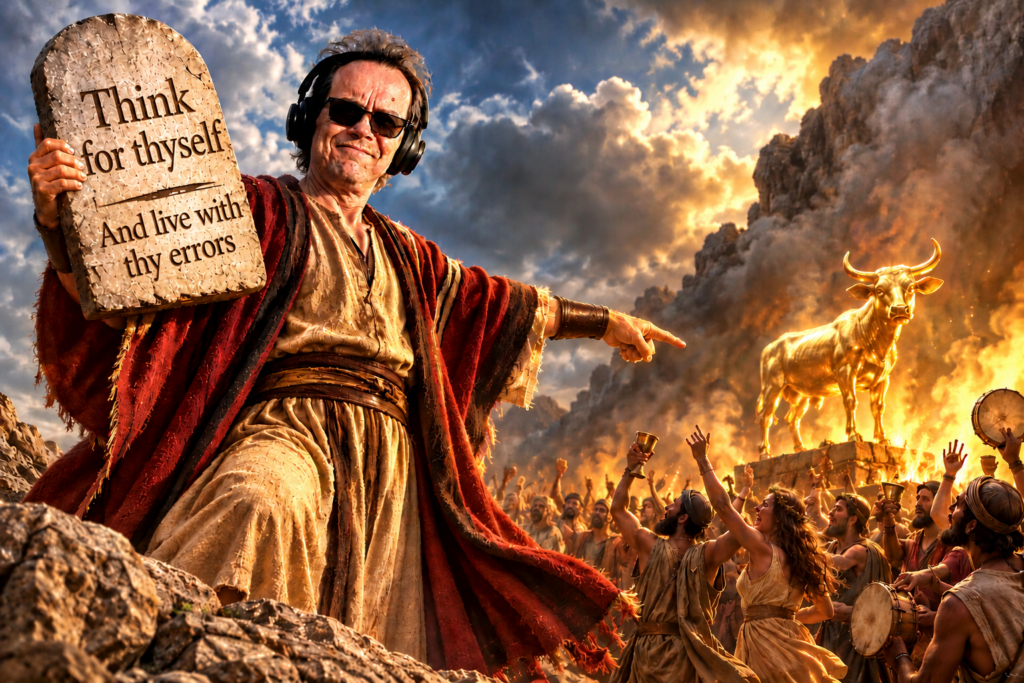
Why we don’t always have to be right
The Lost Cassette
Somewhere out there is a cassette tape. Probably in a landfill, maybe still in a box in someone’s attic. On it are the articles I wrote as a high-school senior for our school newspaper, typed on a Commodore 64, which back then was the future.
Nobody can play it anymore.
What I still have of those texts isn’t their wording but a memory of their attitude. I kept asking the same question back then: What would this world look like if someone described it from the other drawer?
It started in 1987 with the riots in Kreuzberg, in the run-up to Ronald Reagan’s visit, right up to the day the police sealed off an entire district. On West German TV I saw left-wing autonomists using the occasion to stage street battles in Berlin’s traditionally left-wing Kreuzberg. On Aktuelle Kamera, East Germany’s state news, I saw the same streets but different pictures: police officers clubbing apparently harmless citizens. To me it looked like June 17, 1953 in reverse, the East German uprising, only this time in the West. Both channels showed the same events. But editing and camera angles told two completely different realities.
Probably neither of them was lying. I knew the Berlin police of those years myself: even at our entirely harmless school protest against the conference of state education ministers, they were so heavy-handed that I, too, couldn’t shake the feeling of living in a police state. But between heavy-handed and what Aktuelle Kamera or some activists made of it lay a whole world. Each side had simply shown what fit into its tunnel.
How consistently I really thought that way back then, I can’t say for sure today. My worldview at the time was cluttered with articles of faith, too. And those are exactly what this text is about.
The real litmus test for this way of seeing came shortly afterwards: my philosophy degree.
The Shame
At twenty I thought I had the world pretty well figured out.
That lasted about one semester.
Then came the first seminar that took one of my safe assumptions apart piece by piece. Then the next one. I later described it to my kids like this: every semester my worldview got smashed, and every semester I had to painstakingly glue it back together. Hopefully sturdier this time, so it would survive the next cognitive earthquake.
What I felt wasn’t intellectual curiosity. It was shame.
Shit, you’re shallow. The world is completely different from what you thought. And everyone else here obviously knows far more than you do.
What I didn’t understand back then: the others were sitting in the same seminar. And the next one would take them apart too.
The Discovery
After three or four semesters, something dawned on me. Somebody always came along with something else. No matter how thoroughly I worked my way into one perspective, the next bulldozer was already waiting.
That couldn’t be the truth about the world. It was the truth about how we look at it.
I found the language for it not in a seminar but in Robert Anton Wilson. In Prometheus Rising he calls it the reality tunnel. Each of us sees the world through a filter made of origin, language and convictions. The problem isn’t that we have such a tunnel. The problem is mistaking it for the world.
And one of Wilson’s exercises felt strangely familiar: read a news story and consider how the other side would tell it. I’d been doing that in the school newspaper without knowing there was a theory behind it.
In Illuminatus! Wilson quotes Hassan-i Sabbah: “Nothing is true, everything is permitted.” I made my own version of it: Nothing is true, everything is possible. Not as a license, but as a reminder that my tunnel isn’t the only one.
Models, Not Truths
That doesn’t mean I don’t have opinions. I have pretty firm ones, actually. But I treat them as models, not as truths.
A model doesn’t have to be true. It has to explain something, and it has to show where it fails.
That, by the way, is how science works too, even if it rarely sounds that way on talk shows. It’s right until somebody proves it wrong. Anyone who demands that every conviction be justified one hundred percent is demanding something not even physics can deliver. Every chain of reasoning eventually ends at an assumption you can’t prove.
The same goes for numbers. A statistic is just another reality tunnel: it shows what was counted, not why it is the way it is.
And this is where the real relief lies. If you take your convictions for truths, you’re defending yourself with every opinion. Every objection becomes an attack.
If you have models instead, the worst you can lose is a tool. Not yourself.
That’s why I can stand by my opinion and still be wrong. Both at once.
The Door
My kids, incidentally, think I’m extremely dogmatic.
From inside their tunnel, that may even seem understandable. When my daughter tells me about Critical Race Theory and I reply that I consider it a quasi-religious idea, that sounds exactly like dogmatism.
But model agnosticism doesn’t mean every model is equally good. A model that books every contradiction as confirmation is no longer a model. It’s an article of faith.
That’s also what makes postmodernism so seductive. At first glance it sounds like Wilson: there is no grand truth, everything is perspective, knowledge is constructed. That feels humble, and it takes a weight off.
The difference lies in whom you apply the doubt to. Wilson relativizes every tunnel, including his own. Activist postmodernism, whose offspring Critical Race Theory is, relativizes only other people’s truths. Its own model of power and oppression counts as beyond dispute. It doubts outward and believes inward.
That’s why I consider it quasi-religious. Not because it doubts. But because it stops doubting when it gets to itself.
What would change my mind? I can’t know that, otherwise I’d have changed it long ago. Maybe those arguments exist, and the believers I’ve debated so far just couldn’t put them into words. Maybe they don’t exist. What I can say is what won’t change my mind: statistics that only count outcomes and presuppose discrimination as the cause.
Of course there are attempts to prove causes, for instance with so-called correspondence tests. But on closer inspection even these say less than people like to claim. Researchers send out identical applications and change nothing but the name. One study by Germany’s IZA institute sent two equivalent applications each to more than 500 internship openings: those with German-sounding names got around 14 percent more responses than those with Turkish-sounding names. In another study, an applicant with a Turkish name and a headscarf in her photo had to send out about four and a half times as many applications as the same woman as “Sandra Bauer” to be invited to interview as often.
That shows cleanly that people are treated unequally, and I don’t dispute it. But it doesn’t show why. And that’s exactly where a finding quickly turns into a claim it can’t carry.
With women’s names, the picture is less clear-cut than you’d expect. A meta-analysis of almost all correspondence experiments since 2005 actually found a slight overall advantage for women. In the debate about the systemic disadvantaging of women, that comes up surprisingly rarely.
So is this proof of systemic discrimination? In the IZA study, the penalty for the Turkish name disappeared as soon as the application included a reference letter that said something about the applicant’s personality. So the employers had no fixed enemy image. They had too little information and filled the gap with a group assumption. As soon as someone opened the door, it opened.
Also striking is where the big drop comes in the headscarf study. While the applicant with the Turkish name and no headscarf trailed “Sandra Bauer” only by a smaller margin, her rate collapsed to a third only once the headscarf appeared. That points less to a blanket rejection of migrant women than to a reaction to a specific, self-chosen signal.
There, the employer wasn’t reacting to missing information but to information that was right there. You don’t choose your name. You do choose a headscarf on your application photo. Whoever makes their religion visible there is saying something about themselves, and the employer wonders how much friction that might mean for the team. Whether his reading is fair is open to doubt. But even the European Court of Justice ruled in 2017 and 2021 that employers may ban visible religious symbols at work, provided the rule applies equally to all religions and meets a genuine need of the business. So anyone who would rather spare himself that discussion at the selection stage isn’t acting out of racism, as long as he expects the same of a Jew wearing a kippah. And nobody would call it discrimination if an applicant with a mohawk and a studded leather jacket in his photo got invited to fewer interviews at a bank.
That doesn’t make it any better for the person who gets sorted out. But anyone who sees it as proof of a system designed to keep women and minorities down is measuring reality against an unrealistic ideal: the morally flawless decision-maker who looks at every individual case one hundred percent. Why that’s infantile wishful thinking, I’ve explained at length in my piece on Collien Fernandes and cult leaders.
We all make decisions on thin evidence every day. A landlord who can barely get rid of a tenant, even one who pays erratically or trashes the apartment as a serial rent-dodger, chooses more carefully than one who could give short notice and have him out three weeks later. The same goes for an employer filling a key position: a highly qualified woman who becomes pregnant gains almost unbreakable protection against dismissal, and he has to keep the position open during her parental leave without being able to fill it permanently. The harder a decision is to reverse, the more strictly people filter beforehand. The protection meant to help reinforces the caution that excludes.
With a generic application that just lists facts, the name alone can then tip the scales. Nobody has to be a misogynist or a xenophobe for that. It’s enough that he’s risk-averse and knows nothing else.
So what matters isn’t whether we have assumptions. What matters is whether they have a door. Whoever lets the other person correct them with additional information, say a reference letter, is using a model. Whoever only looks at the score or the name and never invites anyone in prevents exactly the information that could correct him. The IZA study points more to the first pattern. And that calls for a different therapy: more information instead of more guilt.
And before anyone gets the idea that I’d have to prove my explanation is the right one: no, I don’t. I’m not claiming to have found the only correct explanation. I’m merely showing that there are other explanations consistent with the same observations.
Whoever infers a specific cause from a statistical inequality has to justify that inference. Maybe my explanation is wrong, maybe it’s only part of the truth.
Of course genuine hostility exists. The crucial question is how often. The IZA study suggests that the committed racist is rarer than the debate assumes. More often it’s probably wariness of strangers, and that needn’t be malice. Throughout human history it was a perfectly sensible survival mechanism. If you want to understand why, just read Asterix and the Soothsayer: a stranger seeks shelter in the village, and soon the whole community is hopelessly at odds. For a long time, a single wrong guest could blow a whole village apart.
It’s part of our evolutionary inheritance, and not even an outdated one. Even today, a single person can blow a team apart, for instance by reading every bit of banter as a racist attack, even though that kind of ribbing is perfectly ordinary in all-German teams and has nothing to do with hostility. The name on the application says nothing about that, admittedly. But only those who understand this wariness, instead of shouting “racism” right away, are ever in a position to convince the landlord, the bank clerk, the hiring manager, in short, the modern village, that it’s misplaced in this particular case.
So if two models explain the same data, it’s worth asking which one actually helps in life. The discrimination model leaves the person affected only one role: that of the victim. He can denounce the injustice and give some NGO a reason to exist, an NGO with nothing better to do than pillory employers or landlords or take them to court. He himself can’t act. Worse still, the victim role can reinforce the bias. Because then anyone who has to make the decision asks himself: Do I really want to take on someone who might answer every bit of criticism with the racism or sexism card? Ironically, the very narrative that sets out to fight this wariness ends up confirming its rationale. Like the soothsayer in Asterix, it divides the village. Except it’s the applicant who pays the bill, not the storyteller.
The narrative has a second side effect, too. In 1980, psychologists at Dartmouth College painted a conspicuous scar onto the faces of female students. Supposedly the study was about how people react to disfigurement. The women looked at themselves in the mirror, and then, under some pretext, the scar was quietly removed. With flawless faces, but believing they were disfigured, they went into a conversation with a stranger. Afterwards they reported that the other person had been tense and condescending and had kept staring at the scar. There was no scar. There was only the expectation. Talk yourself into believing you’ll meet rejection everywhere, and you’ll find it, whether it’s there or not.
The risk model, by contrast, puts something in his hands. He can take the other side’s concern seriously and give them the information they need to make a different decision. That gets him out of the victim role. It gives him agency. If you take other people’s suffering seriously, you give them a solution, rather than making them dependent on the goodwill of the very people you’re busy accusing.
Of course people may tell me that as an old white man I don’t know what I’m talking about. I’m afraid I have to disappoint my critics. I know pretty well what it feels like to be on the receiving end of an assumption.
I even know what it feels like when the law itself puts you at a disadvantage, purely because of your sex. When I acknowledged paternity of my first son in 1996, as an unmarried father I had practically no rights. Custody automatically lay with the mother alone, and she could even have denied me contact with my child. If I wanted to be sure of remaining a father even against her will, I had to marry her. A forced marriage, courtesy of discriminatory laws. It took no statistics to recognize that discrimination.
But I’ve also experienced discrimination based on risk assessment first-hand. I’ve been self-employed for thirty years. To landlords and banks, that means: potentially bankrupt. Every small loan for a used car is a major ordeal for me, while I know women with an averagely paid part-time job in a public authority who get 20,000 euros practically thrown at them. The housing market is even worse. At 40 I was still being asked on an apartment application whether my father couldn’t act as guarantor.
It became downright absurd years later, when I wanted to act as guarantor for my daughter. My credit rating happened not to be spotless at the time, but my income was well above most people’s. The landlord turned me down anyway. The solution: my daughter interrupted her studies, applied for unemployment benefits and came back with the approval letter from the job center. That he accepted.
He preferred someone with no income at all, as long as the state stood behind her, to a self-employed man earning good money. He didn’t decide by ability to pay, but by certainty. He never once looked at my figures.
This landlord had no door. But neither does the theory that declares every inequality to be discrimination.
The dogmatist has no door. The skeptic has one; he just asks who’s knocking.
And that’s exactly why so few debates convince me, especially on social media. Not because nobody has numbers. There are plenty of numbers. But because hardly anyone asks what they actually measure, what they leave out, and why they look the way they do. Whoever throws a number at me that he has never questioned himself isn’t bringing an argument. He’s only bringing his tunnel, the one in which those numbers count as an argument.
Those Who Have to Be Right
What this looks like on a grand scale, Covid showed us.
I’m not an anti-vaxxer. I got vaccinated because back then I was considerably overweight and had circulation problems. If anyone belonged to a risk group, it was probably me. In hindsight I’d have done better to start losing those 25 kilos earlier and get my body fat below 15 percent. But the decision was a weighing-up, not a creed.
What scared me was something else. It was the certainty with which a line was defended back then, even after its justifications began to crumble. Protecting others, the argument used to push for mass vaccination, didn’t hold up. The pressure stayed anyway. And the risk was very unevenly distributed from the start: the average age of those who died was around 80.
So “Follow the Science” was never a scientific statement, but an article of faith. Science isn’t something you follow. It’s a thesis that holds until somebody refutes it. And even the best thesis tells us what is, not what we should do. Science can advise. It cannot lead. And yet that’s exactly the role it was given: that of an authority that tells us what is right. It’s the role God used to have.
Where it leads when you let science lead, the 20th century showed us. Eugenics was considered cutting-edge research back then, taught at universities in the US, in Scandinavia and in Germany. That’s why the Nazis could pass off their euthanasia murders as applied science. The crime began where people believed that what should be done follows from a thesis.
Whether to close schools or let old people die alone is not decided by a study, but by weighing values. Anyone who said so back then was branded anti-science. Yet he was precisely the one who had understood what science actually is.
In April 2020, Jens Spahn, then Germany’s health minister, told the Bundestag “that in a few months we will probably have to forgive one another a great deal.” And he was right. Information was thin, the risks hard to gauge, and the consequences of political decisions barely foreseeable. Mistakes were inevitable. Which is exactly why we would have needed a political culture that allows other approaches, reviews decisions and corrects errors.
Instead we got a politics of “no alternative,” a term Angela Merkel had made popular long before Covid. Scientific findings became political necessities, political decisions became moral obligations. Anyone who wanted to discuss alternatives had to expect to be seen as irresponsible or lacking solidarity. With some professional athletes you could watch in public how a personal vaccination decision was turned into a question of moral belonging.
That was all the more remarkable because it was about restricting fundamental civil liberties. In a free constitutional state, it’s not freedom that needs justifying, but its restriction. Yet at times the impression arose that those who wanted to exercise their basic rights had to explain why they thought that was even acceptable.
Spahn’s remark could have been the foundation of a sensible culture of error. The problem wasn’t the mistakes. The problem was that you weren’t allowed to admit them.
And anyone who pointed to Sweden rarely got a counter-argument. He got a label.
The label missed the point: Sweden is precisely not an example of someone being right from the start. The country made serious mistakes in the first wave, above all in its care homes. But it named them. A commission found the government had failed, and the strategy was corrected. In the end it had one of the lowest excess mortality rates in Europe, with far less coercion.
Sweden treated its strategy as a model that was allowed to fail. Germany treated its own as a truth that had to be defended. A serious reckoning began only years later.
And that is exactly the difference. If you’re allowed to be wrong, you can correct yourself. If you have to be right, you can’t.
Why We Cling
At university I learned that even “grass is green” isn’t an entirely simple truth. All that’s measurable is which wavelength the grass reflects. The “green” is only made by our eye. A color-blind person sees it differently, and a bumblebee, which perceives ultraviolet, even more so. If even grass is a model, how much certainty is left for politics, morality and taste?
Of course there are objective truths. Gravity couldn’t care less whether I believe in it. But between the existence of an objective truth and our ability to recognize it beyond doubt lies a considerable gap.
Take a paternity test. Actually a nice example of a clear-cut truth. Either I’m the biological father of a child or I’m not. There’s not much room in between.
Only even a modern DNA test, when it confirms paternity, gives us not absolute certainty but a statistically calculated probability. It may be 99.99 percent or higher and good enough for practically any sensible decision. But it isn’t one hundred percent.
That doesn’t make the test any worse. It simply shows that even where reality is unambiguous, we work with models and probabilities to recognize it.
And of all places, it’s the questions that break up friendships, tear families apart and split whole societies into hostile camps where the truth is often far harder to discern.
Who’s to blame when a relationship fails? What is fair? Which political decisions are right? What do parents owe their children, and children their parents?
Here facts blend with interpretations, personal experience with values, and understandable interests with moral convictions.
And it’s exactly where we can have the least certainty that we defend our convictions most doggedly.
So why do we cling to our opinions as if they were truths about the world?
You see it most clearly where there’s no truth at all: music. People defend their favorite music as if their lives depended on it. Yet hardly anyone, me included, could even explain what makes music good. And it doesn’t matter. Music is communication. It speaks to some people and not to others. The Sex Pistols were probably not much as craftsmen, and still they told people something about the world that mattered to them.
So where does the fighting come from? Because music says something not only about the world but about the listener. Whoever thinks my music is bad doesn’t seem to be telling me “this doesn’t speak to me” but “you don’t belong.”
Whether a bumblebee sees grass as green upsets nobody. Whether the Sex Pistols made music does. The less a question matters to our identity, the more calmly we tolerate different answers. It’s an ancient reflex: for our ancestors, belonging meant survival, and whoever got thrown out of the group died. That’s why to this day we defend most fiercely not what keeps us alive, but what makes us count as part of the group.
For millennia, religion was the answer to exactly this reflex. It created belonging, laid down rules and separated the faithful from everyone else. Today we’ve largely made it redundant: the churches are losing their members, and even they increasingly treat their own faith as trivial. But the need has remained. It has simply found new altars, whether the liberation of Palestine or the right diet.
My wife once put it in a nutshell: diet is today’s substitute religion. Our entire digestive system is built on the fact that we eat meat; vitamin B12, for instance, is something plant foods practically don’t provide. Of course you can still live vegan. It isn’t a question of whether it works, but of effort: a healthy vegan diet is considerably more complicated than a healthy mixed one. Anyone who takes on that effort out of moral conviction is of course free to do so.
The problem only begins with the missionary part. Whether we should eat animals is a moral question, not a biological one. Yet it’s argued as if it were: humans are really herbivores, vegan is healthier anyway, and whoever eats meat is on the wrong side of history. A value judgment is dressed up as a fact of nature. Only the disguise doesn’t hold. As a fact of nature, the claim is quickly refuted: our stomach acid is as aggressive as you’d otherwise find in scavengers. That’s a body built to digest even meat of dubious origin without dying of every germ. What remains is morality. That could be debated. Instead, people get converted.
Abstaining is a conviction. Only the mission turns it into a religion.
It’s the same with political opinions, only more is at stake. We don’t cling to them because they’re true. We cling to them because they tell us who we are and where we belong. That’s why disagreement feels like betrayal, and the dissenter becomes the enemy.
I try not to need that. With some people on X I argue tooth and nail about Israel’s right to exist, with others about entirely different things. And yet there are almost always areas where we meet. I don’t have to damn anyone just because he thinks wrongly on one point.
Sometimes I still argue hard, and then preferably with a mirror. When someone on X writes that men finally have to learn they have no automatic claim to their children, I reply with the same sentence about women. Suddenly it sounds unbearable. I haven’t made a new argument. I’ve just shown him the other tunnel.
It’s basically the same exercise as back in the school newspaper: describing the world from the other drawer. Only now I don’t just do it for myself, I hold it up in front of the person I’m arguing with.
The same applies when I write harshly about people. I once said of Jan Böhmermann, the German TV satirist, that he’s a failed existence whose narcissism not even a big stage can save. But it’s no coincidence that the sentence was preceded by: “To put it in his style.” Böhmermann makes his living hanging moral labels on others and deciding who still gets to have a say. When I criticize him, I do it by his own standards. That’s polemic as a mirror, not a worldview.
The difference, again, is the door. Böhmermann declares who one shouldn’t talk to. I’d still debate sex education, Covid or the AfD with him, if he were willing. Whoever ends up no longer considering the other person fit for conversation has stopped arguing. He has started to condemn.
Nothing Is True, Everything Is Possible
So somewhere there’s that cassette. I no longer know exactly what’s on it. But I know what question the schoolboy was asking back then: What would this world look like if someone described it from the other drawer?
My degree first took that question apart and then confirmed it. In between lay a few semesters of shame, until I understood that the others didn’t know more than I did. They were just standing in a different tunnel.
Even grass is only as green as my eye shows it to me. That didn’t unsettle me; it took a weight off. I don’t have to own the world to live in it. I just have to leave the door open.
Since then I’ve had firm opinions and enjoyed arguing for them, sometimes loudly. But I don’t have to be right to sleep well at night. And I don’t have to see anyone as an enemy just because he sees the world from somewhere else. Especially since on other points he may well be my friend.
Cypher in The Matrix chose the simulated steak because ignorance is supposedly bliss. I think he was wrong. Happiness doesn’t come from denying reality. It comes from making peace with the limits of your own view.
Nothing is true, everything is possible.
Life is lighter when you’re allowed to be wrong.
P.S. If you want to know what the world would look like without a reality tunnel, I refer you to Aldous Huxley. In The Doors of Perception he describes his mescaline trip and borrows a line from William Blake: “If the doors of perception were cleansed every thing would appear to man as it is, Infinite.” That’s no doubt very interesting. But anyone who has ever seen someone on a trip like that knows it’s not a state you can live in for long.
AI-generated podcast based upon the German blog “Der Sexismusbeauftragte Informiert“
belonging correspondence study Covid Critical Race Theory culture of debate culture of error dogmatism epistemology follow the science free speech headscarf housing market identity model agnosticism no alternative postmodernism reality tunnel Robert Anton Wilson scepticism self-employment statistical discrimination substitute religion Sweden veganism